
Best Handmade Moses Baskets for Newborns: Natural Materials
Table of Contents
- Why Handmade Moses Baskets for Newborns Are Worth the Investment
- Quick Comparison: Handmade Moses Baskets at a Glance
- Moses Basket Safety for Newborns: What Actually Matters
- Moses Basket Mattress Requirements: Firm, Flat, and Custom-Fit
- Natural Materials, Verified: Inside a Handwoven Ghanaian Moses Basket
- How Long Can a Baby Sleep in a Moses Basket?
- Care, Maintenance, and Passing Your Basket Down
- Conclusion
- Frequently Asked Questions
Last Updated: October 17, 2026
Why Handmade Moses Baskets for Newborns Are Worth the Investment
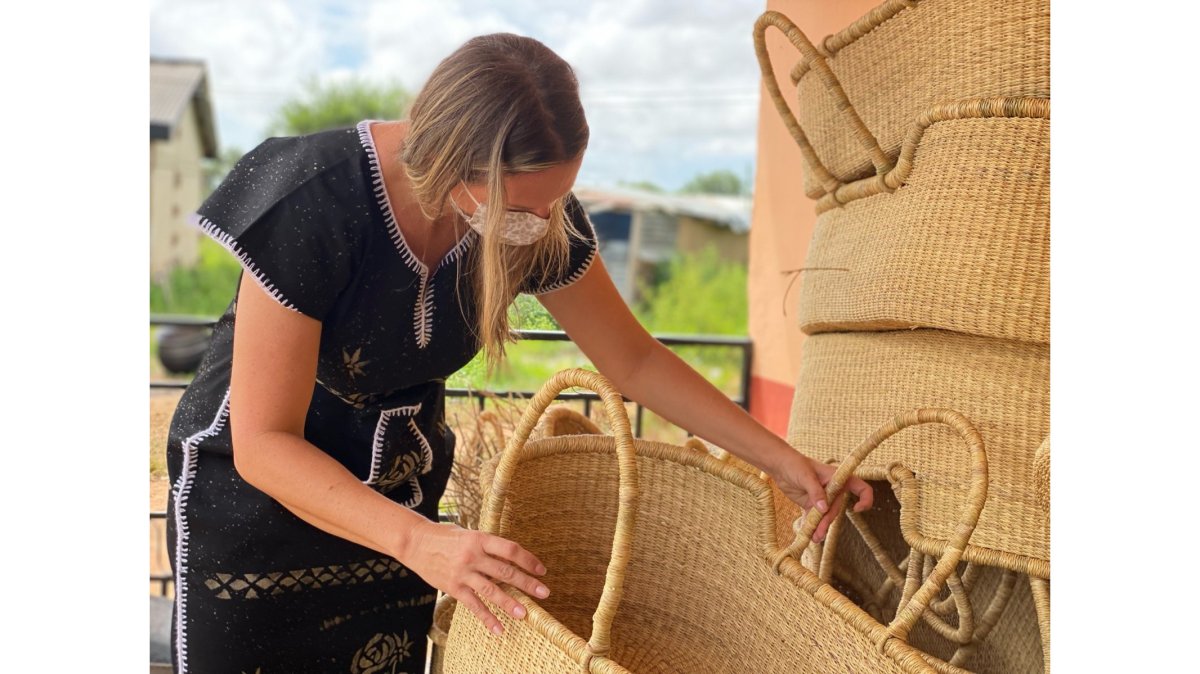
Handmade Moses baskets for newborns give you something a plastic bassinet cannot: a small, breathable, portable sleep space woven by hand from natural materials, made to be kept and passed down. At Plum+Sparrow, our baskets are woven by mothers and women in Ghana through our artisan workshop, Woven Roots, from natural elephant grass.
Here is the honest case for the investment. A Moses basket is not a long-term bed. It is a first bed, used for a short season, then repurposed for years as a storage basket for books, toys, or blankets. You are not buying months of sleep. You are buying a piece that stays in the family.

The premium comes from the making. Each basket is shaped by hand, one at a time, which means no two are identical. Slight variations in color and weave are part of the piece, not a defect.
What most buying guides skip is the safety conversation. A beautiful basket is only worth it if it is used correctly. Below, we cover what actually matters for safe sleep, how to judge materials, and how long your baby can realistically use one.
Quick Comparison: Handmade Moses Baskets at a Glance
All Plum+Sparrow Moses baskets share the same core build: handwoven elephant grass, chemical- and fire-retardant-free, a custom-fit mattress and pom-pom set included, and approximate measurements of 28"-29" L x 15"-16" W x 8"-10" H. The differences come down to handles and silhouette.
| Style | Handles | Best For | Price |
|---|---|---|---|
| Natural Bassinet | Leather, with hood | Classic nursery look, room-to-room carrying | $199 |
| Natural Bassinet No Hood | Leather, no hood | Open, unobstructed view of baby | $199 |
| Modern Open Weave | Vegan handle | Airy, modern aesthetic | $199 |
| Inset Handle | Inset leather | Simplified profile, easy grip | $199 |
| Cream Handle | Cream leather | Soft, neutral nurseries | $199 |
| Fig Moses Basket | Leather | Warmer tones; liner and stand sold separately | $199 |
| Elaine Bassinet | None (stationary) | Fixed stand setup with scallop detail | $220 |
If you want one recommendation: the Natural Bassinet is our most versatile pick. It carries well, suits almost any nursery, and includes the mattress and pom-pom set.

Moses Basket Safety for Newborns: What Actually Matters
Moses basket safety for newborns comes down to three things: a firm, flat surface; a clear sleep space with no loose bedding; and constant supervision.
The American Academy of Pediatrics safe sleep recommendations are the standard to follow. Babies should sleep on their back, on a firm, flat surface, with nothing loose in the sleep area (Safe Sleep). No pillows, no bumpers, no thick blankets, no soft toys.
That answers the question we hear most: are the sides a suffocation risk if a baby rolls into them? The risk comes from soft, padded sides and loose bedding, not from a firm woven wall. Our baskets are woven from elephant grass with a firm structure and no added padding, and they are intended for babies who cannot yet sit up or roll over unaided. Once your baby can roll, it is time to move to a crib.
Moses Basket Mattress Requirements: Firm, Flat, and Custom-Fit
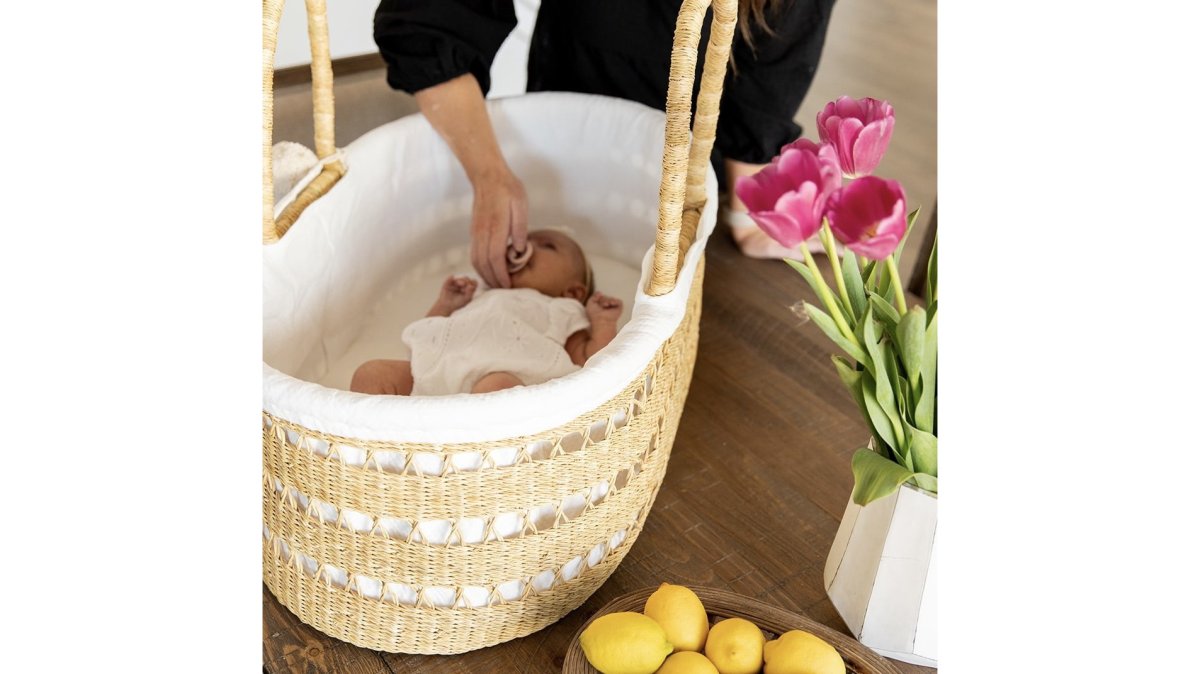
Moses basket mattress requirements are simple: the mattress must be firm, flat, and fit the basket snugly with no gaps around the edges. A gap is a trap for small limbs and a place where a face can press.
Every Plum+Sparrow basket ships with a custom-fit mattress, so the fit is worked out for you. Add a jersey-knit mattress sheet over it, and a waterproof mattress cover underneath if you want protection between the mattress and the sheet.
A note on reflux: if your baby needs to be elevated, a flat Moses basket will not do that. Elevation is a conversation to have with your pediatrician, not something to improvise with towels or wedges inside the basket.
Natural Materials, Verified: Inside a Handwoven Ghanaian Moses Basket
A handwoven Ghanaian Moses basket is made by weaving elephant grass strand by strand into a firm, breathable wall. That is the whole construction, and it is why the basket holds its shape and lets air move.
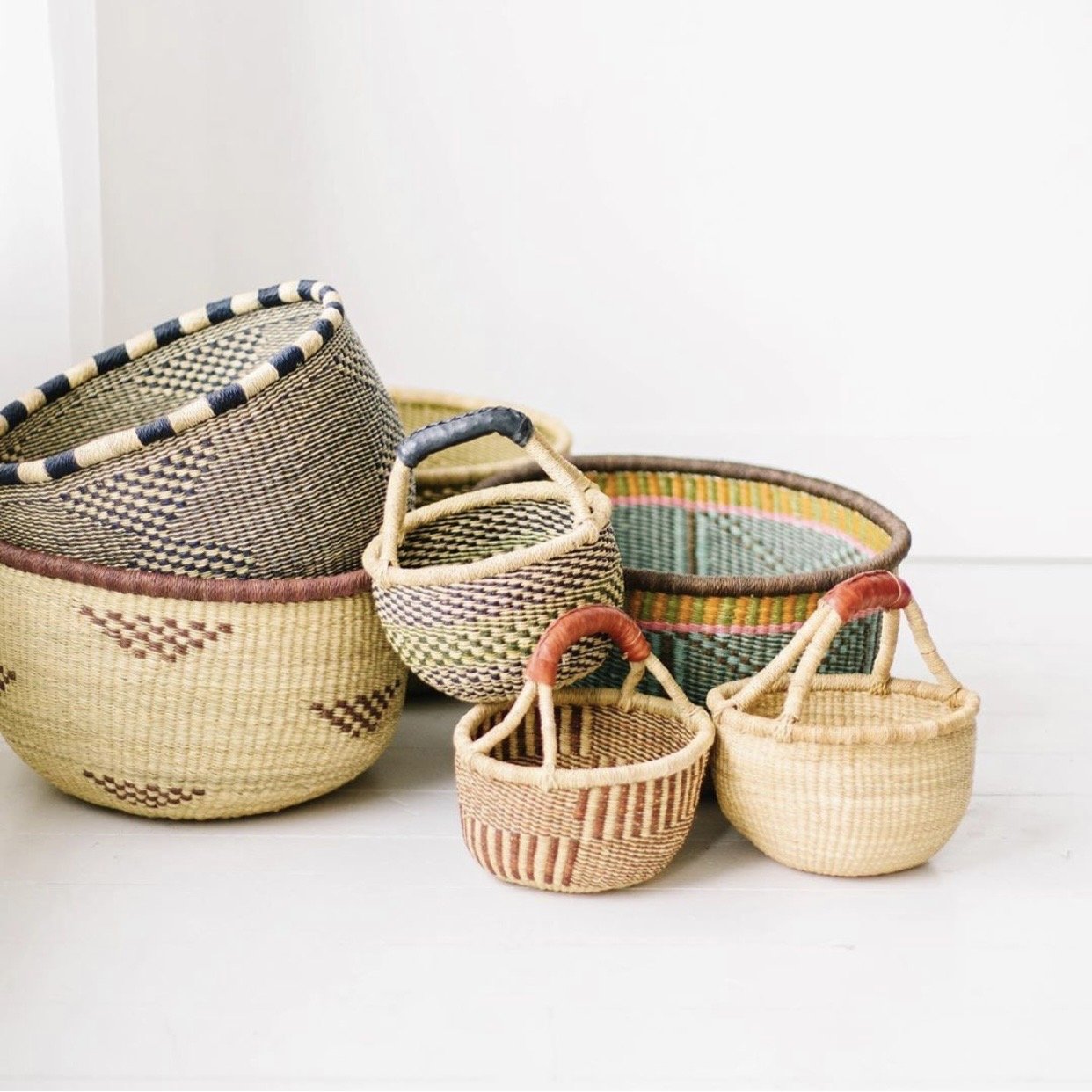
Here is how to verify a handmade and natural-material claim before you buy.
1. Ask who made it, and ask for the workshop. "Handmade" can mean a factory worker finished a machine-woven base. A credible maker can name the workshop, the region, and the relationship.
**2.
3. Ask about finishes and fire retardants. Many woven baskets are treated with chemical finishes or fire retardants to meet retail standards. Ask directly whether the grass is finished, dyed, or coated, and with what.
**4.
5. Look for textile certifications on anything that touches your baby. The grass is only half the story. The mattress, sheet, and liner are textiles, and textiles are where certifications actually exist.
6. Expect variation, and treat uniformity as a warning sign. Hand-dyed leather and hand-woven grass vary in shade and weave. If every basket in a "handmade" line looks identical, it is probably machine-produced.
How Long Can a Baby Sleep in a Moses Basket?
Most babies use a Moses basket for the first few months, and the real limit is developmental, not a number on a box. Stop using it as a sleep space once your baby can sit up or roll over unaided, or when they outgrow the basket's length and width, whichever comes first.
Our baskets are approximately 28"-29" long and 15"-16" wide, designed for newborns and infants who cannot yet sit or roll. Watch for your baby's head nearing the top edge or a hand reaching the side wall. That is your cue to transition to a crib.
The second life of the basket is the point. After your baby outgrows it, it becomes a storage basket for books, toys, or blankets, and it can be passed from child to child.
Care, Maintenance, and Passing Your Basket Down
Care is where natural materials reward you or punish you, depending on how you treat them. The goal is simple: keep the grass dry, keep the shape firm, and inspect the basket before each baby uses it. Here is how common natural basket materials compare on practical points.
| Material | Breathability | Durability | Weight | Cleaning | Likely wear over time |
|---|---|---|---|---|---|
| Elephant grass | High, open weave moves air | Firm and springy; holds shape well | Light to carry | Spot-clean with a barely damp cloth; air-dry fully | Slight softening at the rim; color deepens |
| Palm leaf | High | Stiffer, can crack if dried out | Light | Spot-clean; avoid soaking | Brittleness in dry climates |
| Maize husk | Moderate to high | Softer, less rigid | Very light | Spot-clean only; reshapes easily | Compresses and loses firmness sooner |
| Willow | Moderate | Very sturdy, heavier build | Heavier | Wipe clean; keep from damp | Darkening and stiffness at joints |
| Cotton (liner, sheet, mattress cover) | High | Wears with washing | Light | Machine-wash per care label | Pilling and thinning at seams |
A few care rules apply to every natural basket:

- Keep it dry. Do not store it on a damp floor or against a cool exterior wall. In a humid climate, air circulation is your friend, do not press it into a closed closet.
- Keep it out of long direct sun. Sun fades hand-dyed leather and dries out grass.
- Reshape after shipping. Your basket may arrive slightly misshapen. That is normal for handwoven grass. Reshape it by hand, following our reshaping guide, and it will settle back into form.
- Spot-clean the grass with a barely damp cloth and let it air-dry fully before use. Never soak a woven basket.
- Wipe leather handles clean and let them dry naturally. Do not use harsh cleaners on hand-dyed leather.
- Wash the textiles regularly. The mattress sheet and cover take the mess, wash them per their care labels so the grass does not have to be cleaned as often.
Replacement parts and long-term maintenance. The grass is the durable part; the mattress and textiles are the wear parts. Plan to replace the mattress if it loses firmness, develops a dip, or no longer fits snugly with no gaps around the edges. Keep a spare fitted sheet on hand so a middle-of-the-night change does not leave the basket bare.
Inspect before each baby. Before passing the basket to a sibling or storing it, check for:
- Loose or frayed weave, especially along the rim and base
- Handles that have pulled, stretched, or loosened at the anchor points
- Worn or cracked leather
- A mattress that has softened, flattened, or shrunk
- Any sharp strand ends poking into the sleep space
If a handle or the weave is compromised, retire the basket as a sleep space and keep it for storage.
Storage between babies. Store the basket empty, dry, and right-side up, with the mattress out so air can move around the grass. Do not stack heavy items inside it for long periods, that is what compresses the base. A dry, airy closet shelf is ideal.
Conclusion
The hardest part of choosing a first bed is trusting that a simple, natural option can be the right one. It can, when the materials are honest and the mattress fits.
At Plum+Sparrow, every basket is handwoven from elephant grass by artisans in Ghana, free from chemicals and fire retardants, and comes with a custom-fit mattress and pom-pom set. Choose from hooded and no-hood styles, leather and vegan handles, all at $199, or the scalloped Elaine Bassinet at $220.
Browse the full collection and find the basket your baby will sleep in, and your family will keep.
Frequently Asked Questions
Are natural-fiber Moses baskets safe for newborns?
They can be, provided the basket is used correctly. A safe handmade Moses basket has a firm, flat, custom-fit mattress, tightly woven sides with no loose fibers or gaps, and no chemicals or fire retardants added to the grass. Place it on a stable, flat surface or a compatible stand, always put baby to sleep on their back, and keep blankets, pillows, and bumpers out of the basket. Stop using it once your baby can sit up or roll over unaided, since that is when the shallow sides stop being protective.
What should I look for in a Moses basket mattress?
Look for a firm, flat surface that fits the basket snugly with no gaps along the edges, since gaps let a newborn's face press into the sides. The mattress should be thin enough that the basket's sides still sit well above your baby, and it should have a washable cover or a fitted sheet made for that exact basket. Plum+Sparrow baskets arrive with a custom-fit mattress and pom-pom set, and you can add a jersey-knit sheet or waterproof cover sized to the same dimensions.
How long can a newborn use a Moses basket?
Most newborns use a Moses basket for the first few months, typically until they begin rolling over or sitting up unaided, which often happens between three and six months. The basket you choose should be long enough that your baby is not touching the ends and deep enough that the sides still contain them. After that stage, the basket is not a safe sleep space, but it can live on as a storage basket for books, toys, or blankets.
Can a handmade Moses basket be reused for a second child?
Yes, and that is one of the strongest reasons to buy one. A well-made handwoven basket from a handwoven Ghanaian Moses basket workshop holds its shape for years when stored dry and reshaped after shipping. Replace the mattress and bedding between children for hygiene and firmness, check the weave and handles for wear, and keep it away from damp storage. Many families pass these baskets down and then use them around the house for storage once the baby days are over.

Leave a comment
This site is protected by hCaptcha and the hCaptcha Privacy Policy and Terms of Service apply.