

Are Handwoven Moses Baskets Made by Women Artisans Worth It?
Last Updated: October 25, 2026
Quick Summary
Handwoven Moses baskets made by women artisans are worth it for parents who want a portable, natural-fiber first bed with a traceable maker story. Each basket is woven by mothers and women in Ghana, arrives with a custom-fit mattress, and later serves as storage for books, toys, or blankets.
- Most babies use a Moses basket for roughly the first three to four months, until they roll or push up.
- A basket is a supervised sleep space, not an overnight crib substitute.
- Check that the mattress sits flush against all four interior walls with no gaps.
- Elephant grass holds its shape well over years; palm leaves give a softer, more flexible weave.
- Plum+Sparrow baskets are handwoven from natural elephant grass and finished without chemicals or fire retardants.
Why Handwoven Moses Baskets Made by Women Artisans Stand Apart
Handwoven Moses baskets made by women artisans are portable, natural-fiber sleep spaces woven by hand rather than stamped out in a factory. Each one carries the small irregularities of human work: a slightly different curve at the rim, a variation in tone where the grass dried. That is the point, not a flaw.
The appeal runs deeper than aesthetics. A handwoven basket is light enough to carry from bedroom to kitchen to living room without waking a sleeping newborn, and sturdy enough to hold its shape through daily use.
Below, this guide covers what to expect from newborn days, how to use a basket safely, how long it lasts, how to care for natural fibers, and how to trace the artisan story behind the weave. For a broader look at comparing options, read how to choose a Moses basket.
A Moses Basket for Newborn Days: What to Expect
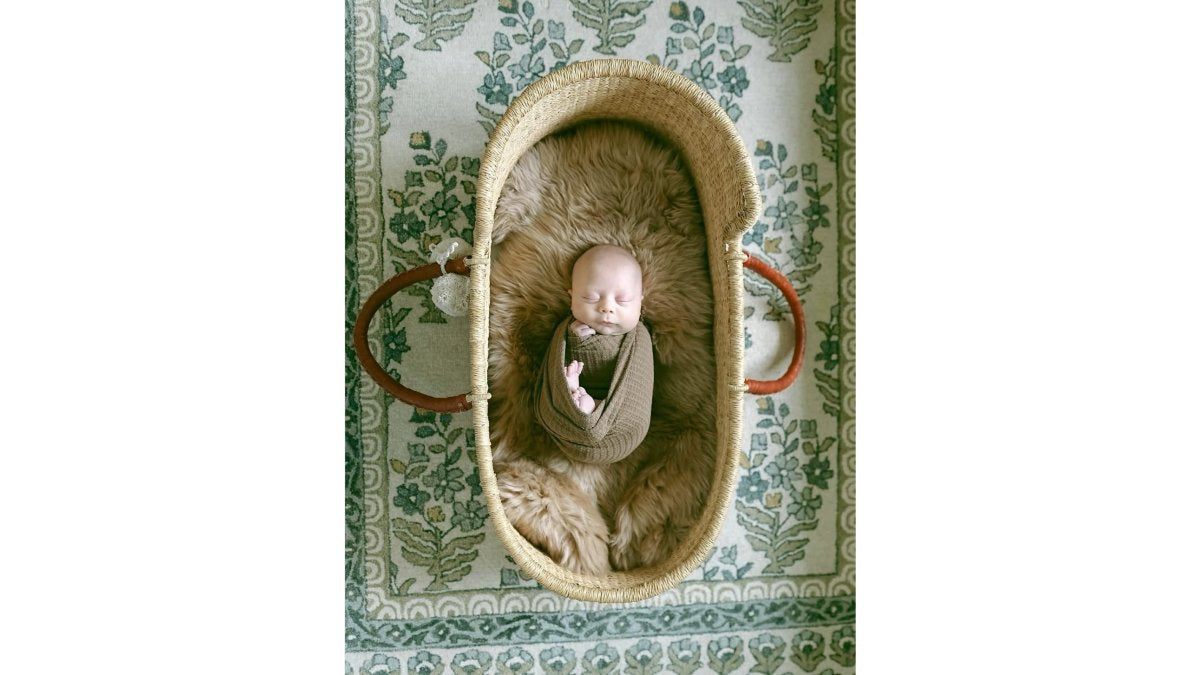
A Moses basket is a small, shallow, portable bed for a newborn, traditionally woven from natural fibers and designed to be moved easily from room to room. The first weeks with a newborn are mostly about proximity. Babies sleep often, wake often, and want to be near a caregiver's body and voice.
That is where a basket earns its place. It creates a cozy, womb-like pocket that feels enclosed rather than vast, and it travels with you. A common mistake is treating a basket as a permanent crib replacement. It is not.
What most guides miss is how much the basket changes the rhythm of a household. Instead of one sleep location, there are many, and the baby stays within arm's reach while laundry gets folded or dinner gets made.
Moses Basket Safety: What Every Parent Should Know
Moses basket safety comes down to three rules: a firm, flat mattress that fits snugly and no loose bedding or pillows around a sleeping baby.
The American Academy of Pediatrics recommends that infants sleep on their back on a firm, flat surface with a fitted sheet and nothing else in the sleep area (How to Keep Your Sleeping Baby Safe: AAP Policy Explained). That guidance applies to a basket exactly as it applies to a crib.
Watch out: a mattress that leaves gaps at the sides lets a newborn's face press into soft space. For step-by-step placement guidance, see how to place a baby in a Moses basket safely.
How Long Can a Baby Use a Moses Basket?
Most babies use a Moses basket for roughly the first three to four months, until they begin to roll over, push up on their hands, or reach the basket's weight limit. The exact window depends on the baby, not the calendar.
Two milestones end basket use: rolling, and sitting up unaided. Once a baby can roll, the shallow sides stop being a boundary. Some parents transition earlier simply because their baby is long or active. Others get a few extra weeks with a smaller newborn.
The honest limitation: a basket is a newborn-sized space, and it is designed that way. Expect it to serve one season well rather than several years. What it lacks in longevity as a bed, it makes up for afterward, when it becomes a storage basket for blankets, books, or toys.
Plum+Sparrow baskets are handwoven from natural elephant grass, finished without chemicals or fire retardants, and arrive with a custom-fit mattress and pom-pom set.
Variation is part of the material story. Because each basket is handmade and the leather is hand-dyed, color and appearance differ slightly from piece to piece. For a closer look at natural-fiber options, browse handmade Moses baskets for newborns in natural materials.
Caring for Your Basket: Cleaning, Reshaping, and Moses Basket Storage Ideas
Natural-fiber baskets need very little, but they do need the right kind of little. The rules differ by fiber, so match the method to the weave.
Elephant grass (stiff, structured weave):
- Dust weekly with a dry, soft cloth or a vacuum brush attachment on low suction.
- For spills, wipe immediately with a barely damp cloth and let the basket air dry away from heat and direct sun
Reshaping after shipping: a basket can arrive slightly compressed from transit. Reshaping is normal: simply wet the basket and gently press the walls back into form with clean hands and let the basket settle for a day.
Stand use: if you use a stand, check the basket-to-stand fit each time you set the baby down, and keep the stand on a flat, stable surface away from cords, curtains, and pets.
Once a baby outgrows the basket, the second life begins. Moses basket storage ideas that work well include:
- Blanket and towel storage in a nursery corner
- A book basket beside a reading chair
- Toy storage that looks intentional rather than plastic
- A catch-all near a bedroom door for hats and small items
- A laundry basket for a newborn's clothes and cloths
That second life is why many families treat a basket as an heirloom rather than a purchase.
The Women Behind the Weave: Artisan Livelihoods and Fair Trade
Every basket has a maker, and that maker's livelihood is part of the product.
Fair trade and ethical sourcing are easy words to print and hard to verify. The practical test is transparency: can a brand name the workshop, describe the relationship, and explain how artisans are compensated?
This is the part most buyers do not think to ask about, and it is the part that changes what a purchase means. To understand the wider impact, read about how buying artisan home goods supports craftsmanship.
Finding Your Handwoven Moses Basket at Plum+Sparrow
Choosing a basket comes down to three checks: a firm, snug mattress, a weave that holds its shape, and a maker you can trace. Plum+Sparrow builds its collection around all three, with handwoven Moses baskets made by women artisans in Ghana and finished without chemical treatments.
The collection includes Vegan Handle Moses basket, the Fig Moses Basket along with the Moss Green Vegan Handle, Cream Handle Moses basket, Cognac handle Moses basket.

Best for: parents who want a portable, natural-fiber first bed with a traceable artisan story. Skip if: you need a crib substitute for overnight sleep or a basket for a baby who already rolls.
The newborn season asks a lot of parents, and the gear that helps most is the gear that keeps a baby close without adding clutter or worry. Plum+Sparrow handwoven Moses baskets are made for exactly that: natural elephant grass woven by women artisans in Ghana, a custom-fit mattress included, and a lightweight design that moves through the house with you. Get started with Plum+Sparrow and give your newborn a cozy first bed that can be passed down and used again long after the newborn days end.



Leave a comment
This site is protected by hCaptcha and the hCaptcha Privacy Policy and Terms of Service apply.